Use of the wavelets: application


Application of the theory of the decomposition based on wavelets.

Tools:

We use 2 primary tools: wt2d and mres2d.
 
Inputs These 2 functions use 2 types of arguments: 
  • High-pass and low-pass filters:

  • To carry out a transform based on wavelets simply, the operation of filtering is used. Thus, for each wavelet, one creates 2 filters called (because of their spectrum) high-pass and low-pass. The high-pass filter gives access to the coefficients of the decomposition whereas the low-pass one produces the residue of decomposition. For more precision, it is better to consult the theory. 
  • The resolution which corresponds to the order (level) of the decomposition.
Outputs
  • wt2d carries out a complete decomposition (i.e. by producing coefficients and residues) and produces a result in a "pyramid" format.

  • To each order, the residues (of low-pass) is placed at the top, on the left of the corresponding sub-image. The horizontal coefficients (left the high-pass filter) are at the top, on the right. The vertical coefficients are at the bottom, on the left. And the diagonal coefficients are at the bottom, on the right of each sub-image. 
    Each sub-image is deduced starting from the residues of the last one.

    Example at the order (level) 2: 

  • mres2d carries out the same decomposition but produces only one image, with the size of the source image.


Examples:

Example in Java of compression based on a wavelet decomposition Multi-media Image Systems Compression


Application:

The residues correspond to a denoised or attenuated image.
For all the resolutions, the coefficients of the images only have few coeffs in common.
 

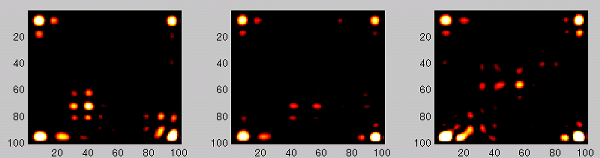
Images of the coefficients to order 3, wavelet Daubechies. Each image comes from a different source, but the first two images are from the same iris. We can notice a similarity between the first 2 images, compared to the third. This similarity relates to relatively few information (surface\intensity).

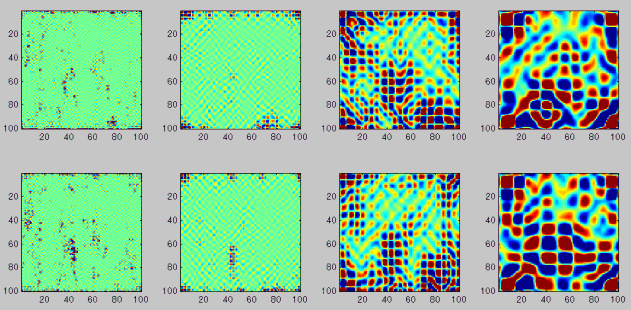
Image of the coefficients to orders 1,2,3 and 4. Each line is a different image but from the same iris. There are some similarities at the order 2 (some vertical features, in the center and in bottom of the image) and a little more at order 3.

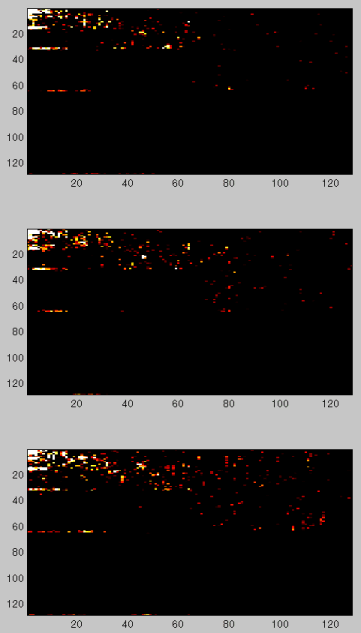
 Pyramidal decomposition. 

Each image corresponds to a different source, but the first two images are from the same iris. 

The coefficients are especially at the top of the image, and, with all the resolutions (shift to the top and towards the left). The weakness of the vertical coefficients  was already noticed in the part " general methods ". 
 

This type of decomposition is relatively not very practical for the comparisons of the irises because the images are not separable (it is obviously not useful to seek the vertical coefficients here). Despite of that, there is a significant resemblance between the first two images.

In all the cases, we can notice the similarities of the decompositions of the same iris. But they are not always very clear.


Return Synopsis Continuation