
The transformation is done with the wavelet transformation tools, and using oriented filters.
==== >>>>>

Filters are applied to rectangular transforms of the eye.
| The source image is similar to:
|
==== >>>>>
The transformation is done with the wavelet transformation tools, and using oriented filters. ==== >>>>> |
|
We obtain nbr_orientations * nbr_levels images. It is noticed that the greatest quantity of information is on the first orientation (at the top, on the right: horizontal orientation). Indeed, we have already noticed that the information on the iris is more abundant in a circular course than in radial course.
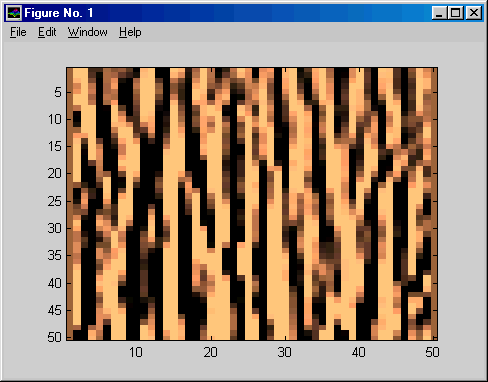 |
Example of extracted cell:
This cell is the orientation 1 (horizontal) and order (or scale) 2 of
the image above.
Despite of the noise, we notice:
|
To compare 2 irises, we compare their 2 decompositions, image by image.
I.e. orientation by orientation and level by level.
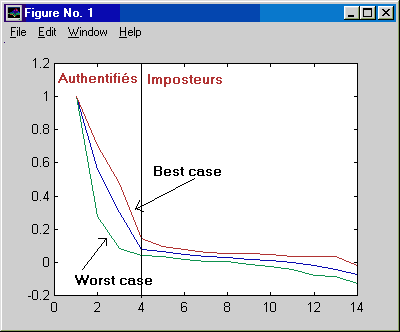 |
Results of the comparisons.
In X-coordinate: images. For each eye, we have use 3 different images, which corresponds to 3 photographs of the same eye, taken at different moments. In ordinate: values. The initial image is identical to itself and thus has an equal correlation has 1. One authenticated has a value from approximately 0.3 to 0.8. An impostor receives a usual value at approximately 0.07. In green: the worst of the cases (worst authenticated with worst impostor)
|
The attentive observation of these curves shows a significant detail:
An impostor carries out a better result on the " Best case " than
the worst authenticated of the " Worst case ".
If this impostor had carried out an imposture of this " quality " on
the worst of the authenticated, would he have succeeded in being authenticated?
Fortunately, it seems that it is not the case: The information obtained
by this method is not equiprobable and an impostor carrying out a better
score than the worst of the authenticated is as probable as an impostor
carrying out better score than the best of the authenticated.
| Thus, it was seen that worst case is very different from best.
We look at the " distance " between the worst of the authenticated and the best of the impostors: |
Worst Mean Best
Score of worst of authenticated --------------------------------= 2.40 5.15 8.49 Score of best impostor |
Improvements:
| Return | Synopsis | Continuation |